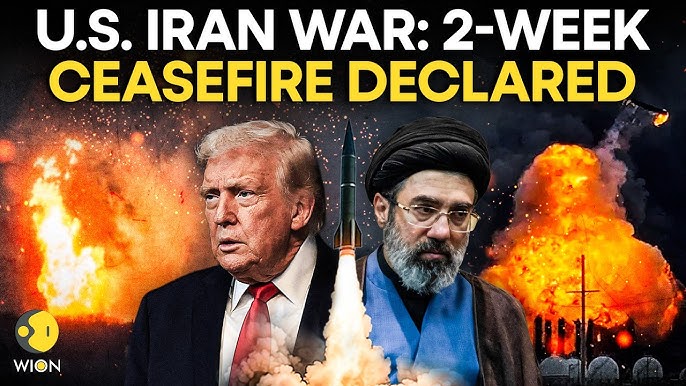
Now that a tentative cease fire has been announced bringing the US bombs into Iran to a halt, it is time to ask the logical question. Who won?
Certainly not the US. Trump basically capitulated to Iran in order to release its stranglehold over the Strait of Hormuz. It had effectively countered US bombs by choking off 20% of the world’s oil supply along with a third of the world’s nitrogen ingredients for fertilizer. Even Trump’s MAGA base was up in arms over the high cost of gasoline and fertilizer. So Trump was willing to essentially surrender.
The sheer cost of the 100-day military fiasco was staggering. The Pentagon admits exhausting almost 30 billion dollars in the war effort, and leaving thousands dead, including 13 US service men and women. The wider economic impact of the war has been estimated at almost a trillion dollars.
What did the US achieve with that? Go through the list of objectives that Trump had enunciated at one time or another in his shifting attempt to justify the war: the elimination of Iran’s nuclear capability; control of Iran’s oil production; regime change to a Venezuela-like transfer of power; the creation of a more moderate leadership willing to work with the US; the stimulus for a popular uprising against the regime.
None of these have happened. The situation is now worse than before the US attack, with a hardened regime and Iran’s continued manipulation of control of the Strait of Hormuz. And it is much worse off than after the five-nation nuclear restriction that was negotiated during the Obama administration. That not only had a pledge from Iran never to develop or acquire nuclear weapons, but also included an extensive monitoring system to make sure that the agreement was fulfilled. As you may recall, Trump tore that up during his first administration.
If Iran forced Trump to capitulate, then it won, right? Well no, since it is now far worse off than before the war. Not only has much of its nuclear and military infrastructure been devastated, its leadership cadre has been decimated. The new leaders lack experience and tend to be more ideologically driven than their predecessors. The Iranian people bear the brunt of these disasters, suffering from a collapsed economy and violently controlled by paranoid leaders.
Well then, Israel should be happy, since it was Prime Minister Benjamin Netanyahu who urged Trump to attack Iran in the first place. For a while, the Israeli public was wildly happy, thinking that their long enemy, Iran, and its ally, Hizbollah in Lebanon, would be vanquished. That didn’t happen, and when Trump wanted to capitulate, the mood in Israel soured against both Trump and Netanyahu. The telephone conversation between the two on the day that the deal with Iran was announced—on Trump’s birthday—was described as “difficult.” So Israel didn’t win either.
Neither did all of those ex-patriate Iranians who hoped that finally the evil regime was finished. It now is worse. Their hopes have been crushed.
Other Arab countries in the area have also been wounded from the Iranian shelling from missiles and drones. Moreover, their faith in the US as a reliable partner to maintain stability in the region has been shattered. US-Middle East relations may take some time, if ever, to restore to its previous cozy state.
Even Russia, the one country that has profited most from the war since it elevated the prices of its own oil in sales to China, India, and elsewhere, has not won from the fighting’s end. Even partial opening of the Strait of Hormuz means a lowering of the global price of oil, greatly affecting Russia’s income.
So after the Iran war it seems no one really won. Then who lost? It is like the old Agatha Christie mystery about who committed the murder on the Orient Express: everyone.
Now that there is a shaky ceasefire in the US-Israel war on Iran, it is time to tally up the scorecard and assess who won and who lost. As I see it, now that the dust is beginning to settle it’s becoming clear what the outcome has been.
BIG WINNER
Russia. Curiously the biggest single winner of the war is a party that was not directly involved in it. It is alleged that Russia’s President Vladimir Putin has been supplying Iran with missiles, however, though Putin has denied it. He would have good reason to do so, since Russia’s economy is almost solely dependent on the international sales of its oil reserves, and with the blocking of the Strait of Hormuz that limits access to Iranian and Gulf States’ oil the price of Russian petroleum has risen significantly and their economy is thriving. Moreover, the Iran War has been a huge boon for the Russia efforts in Ukraine. In the forty days of the Iran siege, the world’s attention has turned away from what Russia is trying to do in Ukraine. Even more problematic is the devastation of the US armament supply. With the constant rain of missiles on Iran, the US will have trouble replenishing Ukraine’s defense efforts. Moreover the US no longer has the moral high grown to criticize Russia for invading another country needlessly. If we can do it, so can they.
SEMI-WINNERS
Iran. At first glance it appears that Iran was a big winner. The cease-fire deal essentially amounted to a surrender by the US. It agreed to stop bombing if Iran opened the Strait of Hormuz, which is exactly where we were before the US and Israel started attacking the country. At the same time, though Iran has emerged victorious it is badly battered. The missile strikes have been devastating to its military infrastructure, including its bases and leadership. Even so much of the essentials are intact. The Revolutionary Guard remains strong, including the dreaded Basij militia, which savagely counters any attempts at resistance to the regime. More important for the leadership, the political infrastructure is solid, despite the assassination of many of the top political and military leaders. They were quickly replaced. A new Ayatollah has been declared, the son of the previous one, who is reported to be even more of a hard-liner than his father. The popularity and support for the regime has sky-rocketed, for nothing unites a country like a foreign attack. Even many of those who despised the Ayatollah and the Islamic regime supported the efforts to stave off American assaults and Trump’s demands for political control of the country. The regime has never been stronger. There is no hope of a deal to limit nuclear arms in Iran, and in fact the country has even more reason to increase the speed of developing fissionable grade Uranium and nuclear devices, now that it no longer trusts the US and is determined to develop the strongest defenses it can produce.
Israel. Although there is grumbling in Israel over the ceasefire among those who say that the war efforts did not amount to anything and that Israel should have stayed in it and finish the job, it is likely that Prime Minister Bebe Netanyahu came out ahead. He is said to have goaded Trump into these Iran attacks, and for good reason. He desperately wanted to have something to deflect the Israeli public’s attention from his continuing legal troubles, and to demonstrate his strength, especially following the catastrophic Hamas attacks and his unsuccessful attempts to rid Gaza of every trace of Hamas by obliterating much of the territory. Hamas is still a potent force in the territory. After assassinating leaders of Hamas and Hezbollah, the head of the Ayatollah remained his main prize. Trump helped him accomplish that. And despite the Iranian missile and drone attacks that have landed on Israel’s soil, Netanyahu’s popularity has soared. It’s said that over ninety percent of Jewish Israelis were behind his war efforts.
Trump personally. The mainstream news media has characterized Trump’s leadership in the war as bizarre and pointless. He is increasingly accused of showing signs of early dementia, and his stature as President is even lower after the war than before. Yet the Iran war has masterfully taken all the oxygen out of news media. For the forty days of the war, no one was talking about the Epstein files, even though the bombshell information about a 13-year old girl alleging to the FBI that she had been raped by him was revealed just at the time that Trump launched the attacks on the Ayatollah. Though the American public in general was opposed to this Iranian adventure, the Republican base was solidly behind it. For Trump, this was what counts. Moreover, his family profited from the war. His sons Donald and Eric have invested heavily in companies that make military drones and drone components, and are reaping the benefits.
LOSERS
Ukraine. To Russia’s delight, the attention of the American public has shifted away from Russia’s assault on Ukraine. More important, with the constant bombardment on Iran, the US stockpile of missiles has gotten perilously low, and Ukrainian leaders are worried that Trump has depleted the supply that is necessary for Ukraine to continue its defense.
Lebanon and the Gulf States. In retaliating against the attacks on their country, Iran has targeted not only Israel but also sites where the US military has bases. Iran has attacked locations in UAE, Qatar, Kuwait and Bahrein. Inevitably there has been collateral damage to civilian areas near those military sites, as the countries scramble to defend themselves. In Lebanon, Iran’s ally Hezbollah has sent missiles into Israel, with huge counter strikes against Hezbollah in Beirut and Southern Lebanon. The Lebanese government has attempted to distance itself from the Hezbollah- Israel conflict, though many areas of the capital and elsewhere in the country have been destroyed.
Europe. Leaders of European nations have been conflicted about how to respond to the US attempts to get their support for the war. The Iranian attack is hugely unpopular among the European public, and France’s President Emmanuel Macron has denounced the US attacks. British Prime Minister Keir Starmer initially withheld the US of British military bases for the Iranian war efforts, but then relented. European countries were trying to find a way to avoid Trump’s wrath but appease their own anti-war public. Increasingly Europe appeared marginal to this regional conflict.
United States. Perhaps the biggest loser has been the United States. An economy already battered by the erstwhile tariffs has gotten worse. Gas prices have soared since the blocking of the Strait of Hormuz that prohibits access to Iranian and Gulf States oil reserves. There is such a backload of oil produced that many of the storage tanks in the region are full. As a result production facilities had to close down. That means that even after the fighting stopped it will take considerable time to get the production facilities working again. The price of oil worldwide, including the United States, will continue to be at all-time high levels. The Iran war is the most expensive in history, costing taxpayers almost 2 billion dollars a day. Inflation is soaring. The US has also suffered in international stature from what appears to much of the rest of the world to be a capricious military act with no clear purpose. The countries that used to consider themselves as allies with the US feel increasingly insecure. Their trend towards self-sufficiency has increased. The US is no longer seen as the stable and reasonable ally as it has been in the past.
The war in Iran – America and Israel’s assault on the country and its barrage of missile and drone responses – have produced a variety of impacts. They might not be exactly what Donald Trump and his buddies had planned on, but clear winners and losers have emerged.
Winners
Iran. Though the missile impact on the country has been devastating to its military infrastructure, it is a large country and much of the essentials are intact. The Revolutionary Guard remains strong, including the dreaded Basij militia, which savagely counters any attempts at resistance to the regime. More important for the leadership, the political infrastructure is solid, despite the assassination of many of the top political and military leaders. They were quickly replaced. A new Ayatollah has been declared, the son of the previous one, who is reported to be even more of a hard-liner than his father. The popularity and support for the regime has sky-rocketed, for nothing unites a country like a foreign attack. Even many of those who despised the Ayatollah and the Islamic regime support the efforts to stave off American assaults and Trump’s demands for political control of the country. The regime has never been stronger. There is no hope of a deal to limit nuclear arms in Iran, and in fact the country has even more reason to increase the speed of developing fissionable grade Uranium and nuclear devices, now that it no longer trusts the US and is determined to develop the strongest defenses it can produce.
Israel. It is likely that Prime Minister Bebe Netanyahu goaded Trump into these Iran attacks, and for good reason. He desperately wanted to have something to deflect the Israeli public’s attention from his continuing legal troubles, and to demonstrate his strength, especially following the catastrophic Hamas attacks and his unsuccessful attempts to rid Gaza of every trance of Hamas by obliterating much of the territory. Hamas is still a potent force in the territory. After assassinating leaders of Hamas and Hizbollah, the head of the Ayatollah remained his main prize. Trump helped him accomplish that. And despite the Iranian missile and drone attacks that have landed on Israel’s soil, Netanyahu’s popularity has soared. It’s said that over ninety percent of Jewish Israelis are behind his war efforts.
Russia. It is alleged that Russia’s President Vladimir Putin has been supplying Iran with missiles, though Putin has denied it. He would have good reason to do so, however. The longer the US pounds away at Iran, the more that the world’s attention has turned away from what Russia is trying to do in Ukraine. Russia’s economy is almost solely dependent on the international sales of its oil reserves, and with the blocking of the Strait of Hormuz that limits access to Iranian and Gulf States’ oil. As a result, the price of Russian petroleum has risen significantly and their economy is thriving.
Trump personally. The Iran war has masterfully taken all the oxygen out of news media. No one is talking about the Epstein files these days, even though the bombshell information about a 13-year old girl alleging to the FBI that she had been raped by him was revealed just at the time that Trump launched the attacks on the Ayatollah. Though the American public in general is opposed to this Iranian adventure, the Republican base is solidly behind it. For Trump, this is what counts. Moreover, his family is profiting from the war. His sons Donald and Eric have invested heavily in companies that make military drones and drone components, and are reaping the benefits.
Losers
Lebanon and the Gulf States. In retaliating against the attacks on their country, Iran has targeted not only Israel but also sites where the US military has bases. Iran has attacked locations in UAE, Qatar, Kuwait and Bahrein. Inevitably there has been collateral damage to civilian areas near those military sites, as the countries scramble to defend themselves. In Lebanon, Iran’s ally Hizbollah has sent missiles into Israel, with huge counter strikes against Hizbollah in Beirut and Southern Lebanon. The Lebanese government has attempted to distance itself from the Hizbollah- Israel conflict, though many areas of the capital and elsewhere in the country have been destroyed.
Europe. Leaders of European nations have been conflicted about how to respond to the US attempts to get their support for the war. The Iranian attack is hugely unpopular among the European public, and France’s President Emmanuel Macron has denounced the US attacks. British Prime Minister Keir Starmer initially withheld the US of British military bases for the Iranian war efforts, but then relented. European countries are trying to find a way to avoid Trump’s wrath but appease their own anti-war public.
Ukraine. To Russia’s delight, the attention of the American public has shifted away from Russia’s assault on Ukraine. More important, with the constant bombardment on Iran, the US stockpile of missiles has gotten perilously low, and Ukrainian leaders are worried that Trump has depleted the supply that is necessary for Ukraine to continue its defense.
United States. An economy already battered by the erstwhile tariffs has gotten worse. Gas prices have soared since the blocking of the Strait of Hormuz that prohibits access to Iranian and Gulf States oil reserves. There is such a backload of oil produced that many of the storage tanks in the region are full. As a result production facilities will have to close down. That means that even when the fighting stops it will take considerable time to get the production facilities working again. The price of oil worldwide, including the United States, will continue to be at all-time high levels. The Iran war is the most expensive in history, costing taxpayers almost 2 billion dollars a day. The US has also suffered in international stature from what appears to much of the rest of the world to be a capricious military act with no clear purpose. The countries that used to consider themselves as allies with the US feel increasingly insecure. Their trend towards self-sufficiency has increased. The US is no longer the stable and reasonable ally of the past.
The massive Israel-US attacks on Iran are aimed, according to President Trump, at regime change. The death of the Ayatollah of Iran will be unlikely to cause that to happen. Most likely a new Ayatollah will be proclaimed and life will go on as it was before.
Yet there is massive unrest in the country, as we have seen in the recent nation-wide protests. The Israel-US attack could be the occasion for a new and larger uprising. As in Libya, Egypt and the Philippines, the uprising could topple the current regime.
If the Islamic rule has been brought to a sudden end, what could happen next?
Chaos, most likely. Iran consists of large ethnic minorities, from the Kurds in the Northwest to the Baluchis in the Southeast. This will be their opportunity for succession and independence.
In the Persian heartland of Iran, internal struggles will ensue. Gangs and warlords will rise up. There is no clear opposition force in the wings that is politically and militarily capable of swiftly moving in and asserting control.
Let’s look at the experience of neighboring countries that have recently gone through political disruptions and regime change. What are the options?
The Iraq scenario
After the ouster of Saddam Hussein the George W. Bush administration expected that the country would immediately come together around a new democratically elected leader. After all Iraq appeared to be well-educated and hungry for an end of dictatorship. The neo-con leaders did not even do much planning for the reconstruction of the country. After toppling the dictator, it was “mission accomplished.”
That’s not what happened, of course. The country was plunged into chaos. What contained the chaos was the occupying force of the US military presence, though it was resented as much or more than the dictatorial oppression of Saddam. Years of confusion and anti-American violence ensued.
Eventually the political forces organized around ethnicity and religion, the two enduring forms of identity and mobilization. Shi’a political parties dominated 60% of the country. Kurds in the north created their own independent region. Sunnis in the northwest mounted resistance movements against both the US and Shi’a rulers that eventually devolved into ISIS.
The Afghan scenario
On the other side of Iran, Afghanistan was going through similar turmoil. The US military easily toppled the Taliban authority largely because its power rested on a coalition of regional ethnic forces. They abandoned the Taliban when it was apparent that they didn’t stand a chance against the American military might.
This put the US in the uneasy position of being the occupying power. It was effective control mainly in the city of Kabul with skirmishes against growing regrouped Taliban militia around the country. Eventually when the US left in a deal worked out by the Trump administration, the Taliban marched back in.
The Syrian scenario
Iran’s main ally in the region, Syria, was controlled by the Asad family and their supporters from the Alawite sect, which is related to Shi’a Islam. The Shi’a connection to Iran was a tight bond that helped to sustain Iran’s influence over the region, along with Lebanon’s Hizbollah party and Yemen’s Houthis.
But Hizbollah and the Houthis have been militarily degraded in recent attacks from Israel and the US. The Asad regime also fell, toppled by an organized Sunni militia that quickly maintained control over the country and became the ruling party.
This was the smoothest transition of any of the recent regime changes in the neighboring countries. It was successful largely because there was already an organized militia and a ruling party in a northern province of Syria that was able to provide security and administration for the country as a whole.
The Yemen scenario
Civil war broke out after the fall of the Saleh regime in Yemen. A militia based in the Houthi ethnic community of northern Yemen rose up against the government and took control of the major city, Saana. The Houthis were followers of a kind of Shi’a sect, which made them natural allies of Iran. The government forces in the south were supported by Saudi Arabia, and the continuing conflict was largely seen as a proxy war between the Saudis and Iran.
The Somalia scenario
After the overthrow of the regime of President Siad Barre in 1991, Somalia plunged into political chaos. Unlike Yemen there were no strong internal powers to define the situation as civil war between two contesting parties. Instead a variety of subgroups and warlords rose up exerting strength in various parts of the country. They operated more like competing gangs than like credible alternative governments.
What Somalia did not have was the occupying power of a foreign country – the US in the case of Iraq and Afghanistan – to provide stability until it found an alternative form of control and political leadership. In the case of Iraq it was a fractured control and leadership, but at least it was not sheer chaos. In Afghanistan it was a return to the old Taliban. As wretched as its rule was for many modern educated people in urban areas it was a stable rule for which much of the rural parts of the country was familiar.
But Somalia did not have an occupying power to provide civil order. It also did not have a well defined militia and political party sufficiently powerful to replace the national leadership and provide stability. What emerged in Somalia was chaos and a failed state.
The Venezuelan scenario
This is not the first dictator that Trump has toppled. Earlier this year a US military raid captured Venezuelan President Nicolas Maduro. The Vice President, Delcy Rodriguez, was sworn in as his successor. Despite previously being a loyal servant to Maduro, and echoing his castigation of American attempts to control the country, she soon appeared to capitulate and meekly work with the US authorities.
It is not inconceivable that the same thing could happen in Iran. The most loyal and ideologically aligned of the Ayatollahs inner circle may either be killed or marginalized in the attacks. The lower echelon leaders of the government may not have the same sense of ideological loyalty to the Islamic Revolutionary State as Khomeini and other leaders have had. To keep their positions of power, the might very well be willing to bow to US demands and work in concert with American advisors in rebuilding Iran’s nuclear and foreign policy. The regime could stay more or less intact, though more open to change.
As in Venezuela, this might frustrate the many Iranians who had hoped for a wholesale political revolution immediately and a return to an unfettered democracy and an open society. And in time the government, now shorn of the need for Islamic ideological justification, might turn increasingly in that direction. In the interim, the post-Ayatollah transition might be surprisingly smooth.
Iran after the Ayatollah
Will Iran after the Ayatollah follow one of these scenarios? Or will it follow a different course? The government is well established and the likelihood is that after the current Ayatollah has been dispatched, another will soon be chosen to take his place. The constitution of the Islamic Republic of Iran requires the office of a Supreme Leader in addition to the usual three branches of a democratic state—judicial, executive, and parliamentary. So a new leader would have to be chosen, and perhaps life will go on without a hitch.
On the other hand, the political turmoil of international conflict linked with major physical assaults on the country leading up to the killing of the Supreme Leader could spark an uprising throughout the country. Iran has experience widescale rebellion before, though this time it could be catastrophic for the regime. It could fall.
If that happens, one of the options that has befallen the other countries in its neighborhood could be Iran’s fate as well. One would hope for the Venezuelan option, though if there is an uprising that ousts the old regime entirely, the outcome might look more like a combination of the Yemen and Somalia scenarios.
There are well-defined ethnic communities within Iran that could break away and form their own semi-independent states. Only 60% of the country is ethnically Persian. There is a large Baluchi community in the southeast that could break away and form ties with the Baluchis across the border in Pakistan.
On the western side of Iran there is a huge Kurdish population adjacent to Iraq’s Kurdistan. When I was in Sulaymaniyah, an Iraqi Kurdish city on the border with Iran, I was impressed on how easily people went back and forth across the border as if it was one region. South of Iran’s Kurdish region is a Kurdish related community, the Lurs. Another community in the far northeast are the Azeris, a Turkish-speaking group related to Azerbaijan.
Each of these could spin off into its own semi-autonomous region. The Persian heartland might be thrown into a Somalia-like confusion with different gangs and warlords competing for power. Years of turmoil would follow.
What might keep this from happening would be the intervention of a foreign power to provide stability. After all, Iran is one of the world’s great oil producers, and the world economy depends on the continued access of this precious resource.
Russia might want to intercede, or China. To keep that from happening, Israel or more likely, the United States would bring in its own troops. Is the United States ready for another unending war of occupation in the Middle East?
I have written a bunch of books relating to incidents of religion-related terrorism around the world, but the one word I have seldom used is “terrorist.” The reason for that is that it is not an analytic term.
Terrorism is a subjective one. It describes persons whose presence or actions have aroused states of terror among those directly or indirectly affected by them.
This means that the definition of a terrorist is given by those who perceived themselves to be terrified. In my interviews with scores of people who were part of activists deemed by observers to be terrorism—vicious acts of terrorism at that—none of them regarded themselves as terrorists.
“We are soldiers undertaking defensive acts,” one of those jihadi extremists involved in the 1993 attack on the World Trade Center told me when I talked with him in prison. He was not a terrorist. Those who shuddered at his attack on the World Trade Center, though, saw it differently. Perception makes all the difference.
When members of the Trump administration immediately labeled as “domestic terrorists” the victims of ICE attacks in Minneapolis that murdered unarmed protesters in cold blood, it gave me pause. Who were they terrorizing? Who was terrorized?
The videos of the murder of Renee Good and Alex Pretti do not show anyone terrorized by their actions. Good’s last words were “that’s fine, Dude, I’m not mad at you.” Pretti’s last words as he shielded a woman shoved to the ground by ICE agents were “Are you okay?”
As the cell phone cameras panned out from the immediate murder sites, though, we could see dozens of bystanders stunned—terrified—by what they had seen. Were they witnessing the actions of domestic terrorists?
The only time I’ve been to Greenland was on an arctic expedition boat surveying the effects of global warming. Ok, it was a kind of cruise, since my wife and I were paying passengers, but it was not the kind of cruise with casinos and free booze. There were scientists on board who gave lectures, and we stopped at sites effected by the catastrophic climatebe change. We saw glaciers melting and the effects of a rising sea.
When we disembarked to go to a research station I was impressed at how rocky and uninhabitable the place was, at least on the Atlantic side. Who would want this desolate pile of rock and ice?
Trump, as it turns out. Yes, there are rare earth metals and other resources under the rapidly melting ice cap. But perhaps the petulant prince wants it simply because it is there, and it could be plucked like forbidden fruit in a neighbor’s garden. Or maybe it is simply what everyone suspects: he has no intention of actually going to war over the property, he just wants to deflect our attention from the Epstein files.
The ruse for going into Greenland is for national security. Of course this would not be necessary if the US had a pact with European nations to defend any of them if they were attacked, and if the US were permitted to put military bases on the island.
Uh… wait, isn’t this already the case with NATO? We have lots of military there already!
But maybe he actually will try to take the island. Assuming the sheep herd of Congress goes along with this wacky idea, the results could be more devastating than immigration raids in Minneapolis. Or he could ignore Congress and send in his ICE goon squads under the pretense of deporting illegal aliens (ie Danish citizens). War on Greenland would mean the breakup of NATO, the most successful peace pact to emerge from the Cold War. But it could also be devastating to the US in other ways.
This internal threat to NATO might be the one that that could unite the often quarreling European powers. If they took a united front in what would be perceived as war against Europe, their retaliation could be more than military.
They could recall the US debt they hold, shattering the US economy
Huge tariffs would seize all European trade. Farewell, BMWs.
US companies would not be able to serve the European market. Sorry Microsoft.
Visa restrictions would make American travel to Europe impregnable.
Air travel would be halted if US carriers were not allowed to land in Europe
US sports teams could not compete in the Olympics and World Cup
Americans would quickly discover that Europeans have always been a part of us. Just as we found with the Hispanic farmworkers that supply our food, without them life as we have known it will dramatically decline.
When ICE comes to Greenland, everyone will suffer.
A Review of Homeland: The War on Terror in American Life by Richard Beck (New York, NY: Crown Publishing group, 2024; 556 pages, hardcover, $33.00)
Every American over the age of thirty knows where he or she was on 9/11. In my case, I was on my way from my home in California to Philadelphia, where I was to give a talk on religious violence. I had stopped over at my parents’ house in Southern Illinois, near St. Louis, and was sleeping in the basement guest room when my older brother came in and woke me with the news. I gave a quick but unprintable response. Just then, my phone started ringing. It would not stop for several weeks. I had just published a book on the comparative study of religious violence that had a picture of Osama bin Laden on the cover. In the publicity tour for the book, I must have gotten into the rolodexes of radio and TV producers as someone who could talk about religion-related terrorism. Now they were desperate to find anyone who could help to make sense of what was going on.
What 9/11 did to disrupt my life, however, was nothing in comparison to what it did to the whole country. In this intriguing and well-written book, Richard Beck has chronicled the ripple effect of that momentous day. The experience grew from stunned shock to a mobilization for warfare that lasted over ten years and still has implications for the country’s economic, political, and cultural life.
On the day of the attack, however, the startled nation did not immediately think of war. As Beck makes clear, the initial reaction was shock, mixed with a deep sense of humiliation, compounded with fear. Dark forces seemed to encroach at the edge of what Americans regarded as the apex of civilized life. Beck invokes the historical memory of early American settlers warring with the shadowy forces of Native Americans as a precursor to this dread of being assaulted and humiliated by the uncivilized unknown.
But how should the American public make sense of this new assault? Beck explains that in the Pentagon, war was already in the air. In my own survey of the newspaper headlines that appeared later that day, in the afternoon editions on September 11, 2001, I found that none of them described the attack on the World Trade Center towers and the Pentagon in terms of war. It was not until the next day when President George W. Bush appeared on television that he said that the attacks were “more than acts of terrorism,” they were “acts of war.” On the Fox News Channel and other television outlets, Bush’s phrase “the war on terror” became incorporated into the standard logo for news reports related to the attack and the US government’s response. The logo would remain for months and years that followed.
In this large and richly reflective book, Richard Beck gives an expansive discussion about how the war on terror has changed American social and political life and laid the groundwork for the contentious politics of the Trump era. The years of mounting paranoia about others, strident xenophobia, and the tightening of political and economic power have led to the moment when a proud and thriving democracy is on the brink of becoming a fearful and frightened autocracy.
The book is large in part because the topic is so broad and the reflections are so rich. But it is also because of the way he writes, which is both engaging and maddening. Beck moves in a meandering style that may strike some readers as annoying, eager to get on with it. But the asides are always thoughtful. Some of them have to do with religion.
A large component of the American paranoia and fear of the other was directed towards Muslims. I remember soon after 9/11 when I was invited to be a guest on Bill Maher’s Politically Incorrect television show, he and one of his other guests went on a screed about the Muslim menace. I tried to make clear that the gang involved in the 9/11 attack consisted of a small, stateless cadre, and that most Muslims throughout the world were as repulsed by the attacks as we were. “That’s what you think,” Maher retorted. It was another guest, the sportscaster, Bob Costas, who came to my defense, affirming that all the Muslims he knew were good people.
American opinion was conflicted about whether Islam is part of the problem. Within an activist political wing of Evangelical Protestantism, however, their judgement was clear. Beck quotes Franklin Graham—son of Billy Graham and heir to his televised pulpit—as saying that Islam was a “very evil and wicked religion” (189). He and other activist Evangelicals claimed that the religion was terrorist by nature. After all, it was founded by a Prophet who was not just a terrorist but “a demon-obsessed pedophile” (189). Beck cites the televangelist Hal Lindsey’s book, The Everlasting Hatred, as saying that the war on terror in general, and the war in Afghanistan in particular, were not just ordinary military engagements. They were a “fulfillment of biblical prophecy” and “a harbinger of the Armageddon” described in the Book of Revelation” (190). Lindsey estimated that ten percent of the world’s 1.4 billion Muslims were terrorists, or potential ones. That calculates to some 140 million Muslim terrorists.
Even though most Christians, including most Evangelical Christians, did not believe that Muslims were evil demons, the extreme Islamophobic position, buttressed by religious ideas, subtly infiltrated American culture and political life. Movies, television shows, and other products of popular culture often featured plot lines where the good guys were battling the bad guys, and the bad guys were frequently Muslim terrorists. Often, a “good Muslim” would be injected into the stories to remind the audience that not all Muslims were evil, but the overwhelming message was that there was something dark and dangerous about the world’s second-largest faith.
The political consequences were dire. Key members within the George W. Bush presidential circle were dubbed “neo-cons,” for neoconservatives, who regarded Western civilization as vulnerable to global forces, including especially the Arab Muslim world. In a widely read article (then made into a 1996 book), the Harvard political scientist, Samuel Huntington, wondered aloud if the post-Cold War world was entering an age of a “clash of civilizations.” Beck notes that Huntington regarded Islam as “a different civilization” that had problems “living peaceably with its neighbors” (203).
According to Beck, the idea of a “clash of civilizations” excited the neocon inner circle of the Bush administration—including Paul Wolfowitz, Richard Perle, and Douglas Feith. Huntington’s idea seemed to vindicate their worldview that Western civilization was under siege. It also gave U.S. Vice President Dick Cheney and Secretary of Defense Donald Rumsfeld the ideological support for the U.S. military invasion of two Muslim countries, first Afghanistan and then Iraq. In toppling Saddam Husain, American was not just removing the threat of weapons of mass destruction, it also was helping Western civilization become more secure. Cheney labored mightily to find some connection between the socialist Saddam and the jihadi Muslims who flew the planes into the World Center and the Pentagon. Alas, however, there was none.
This did not stop right-wing news outlets from continuing to insinuate a camaraderie between jihadi extremists and anti-American leaders throughout the Middle East. It was a view that percolated throughout American culture. The popular support for the US invasion and occupation of Iraq is a remarkable example of the political power of Islamophobia in America during the height of the war on terror.
This reminded me of one incident shortly after the successful military invasion of Iraq, when a crowd of US military, surrounded by chanting anti-Saddam Iraqis (most of them Kurds), gathered at the statue of Saddam in Firdos Square in Baghdad’s center. But before the figure toppled, a young American soldier climbed up and covered its head with an American flag. His military superiors immediately ordered him down and removed the flag, embarrassed at the Americanization of what was supposed to be a great moment for the Iraqi people. When asked the young soldier why he did it, he explained to a reporter that it was in response to the Muslim attack on 9/11. After the soldier was told that Saddam had nothing to do with 9/11, the soldier said that, all the same, he felt that he was getting even.
This insidious and sometimes rampant Islamophobia was religious in two ways. The target of its paranoid suspicions was a religious culture. Moreover, the passion with which these fears were expressed was often fueled by religious fervor. When Islam is decried from the pulpit as “wicked” and “demon-obsessed” it gives spiritual blessings to an ethnic hatred that pervades the war worldview.
In Beck’s astute observation, this othering of Islam set the pattern of racial and ethnic discrimination that persists to this day. When the dominant culture dismisses Muslims as unworthy participants in civilized society, this opens up the permission structure for a whole host of minorities to be similarly demeaned. The subtext of the “Make America Great Again” movement is often an unspoken desire to return to an era when White Christians dominate public life. Though Hispanic immigrants are Christian, they are not White, nor is their religious culture compatible with familiar forms of Protestant or suburban Catholic religiosity. Beck draws a straight line from the Islamophobia unleashed by 9/11 to the fierce anti-immigrant animosity of today.
In an interesting aside, Beck observes that many of the neo-atheists of the first decade of this century utilized a hatred of religion in general to shield their strident Islamophobia. Beck points out that the writings of Sam Harris, Richard Dawkins, and Christopher Hitchens, while blaming religion in general for violence and intolerance over the centuries, were especially virulent on the subject of Islam. In his book, God is Not Great, Hitchens lambasts all religions but reserves a special place for Islam, which he claimed never went through a reformation to adjust to modernity (2007). This reminded me of a time when I got into a disagreement with Hitchens over the war in Iraq, which he supported in part for cultural reasons, at a private salon in Los Angeles. I had the benefit of having spent some time in Iraq, which he had not, so I could evoke actual knowledge of Muslim modernity and rationality rather than just making stuff up.
The American example of toppling regimes it did not like had repercussions far beyond Iraq and Afghanistan. In Beck’s view, the downfall of Saddam awakened similar attempts in other parts of the Arab world. Thus began the rebellions known as the Arab Spring. While they were political and not overtly religious, the populist movements they unleashed were often defined by religious identity and ethnicity. The repression of Sunni Muslims in Syria under the Assad family was countered by angry Sunni militia. Across the border, Sunni Arabs were also marginalized by Shi’a Arab regimes that seized power after the US military toppled Saddam. The two groups of alienated Sunni Arabs combined forces under the banner of the Islamic State of Syria and Iraq (ISIS) that terrorized the region for several years. After the territorial defeat of ISIS and the downfall of Bashar al-Assad, the potency of Arab Muslim anger lingers on in both countries.
In this bold and thoughtful book, Beck has examined the new realities set in motion by the war on terror. He helps us understand that 9/1l was a fulcrum not only in US foreign policy, but also in the American way of viewing the world. It provided a metaphysical template for thinking of White Christian America at perpetual war with the other in ways that have eroded civility and tolerance. It may also have imperiled democracy itself.
References:
Hitchens, Christopher
2007 God is Not Great: How Religion Poisons Everything. New York, NY: Twelve Books.
Huntington, Samuel P.
1996 The Clash of Civilizations and the Remaking of World Order. New York, NY: Simon & Schuster
Juergensmeyer, Mark
2017 Terror in the Mind of God: The Global Rise of Religious Violence, 4th edition, Berkeley; University of California Press.
2025 Why God Needs War and War Needs God. New York: Oxford University Press
My wife’s sister, Gina, feeding a goat at my Santa Barbara ranch a couple of years ago.
Recently we were with my wife’s sister, Gina, when she took her last breath. She was surrounded by family and went painlessly.
We immediately missed her smiles, her laughter, her stories of a convoluted life, from China to Malaysia and then America. She weathered two husbands and had an adoring family.
Where did she go?
I’ve been with four creatures at the moment of their deaths. Well, two were our dogs. But besides them, one was my wife’s mother, and then there was Gina.
The mystery of death is compounded by being close to it. It elevates the question of what happens afterwards to an existential moment. But we all wonder about it much of the time, at the edges of our consciousness. How can we not, since it faces us all?
The popular culture provides us with a cartoon version of heaven. There is an old bearded man in a white robe sitting on a cloud surrounded by other white-robed people looking terribly bored.
Much fun is made about the requirements to get in. The typical cartoon has St Peter sitting at the entrance gate going through his book of approved invitees. One cartoon has an applicant fumbling through his cell phone muttering that he can’t find the right password.
Another has a grateful lady gushing her appreciation, wondering whether it was her good works or her charitable contributions that got her in? St Peter checks his records and tells her, “no, it was on the recommendation of your cat.”
We expect to be reunited with our pets that we liked, along with our relatives, whether we liked them or not. One cartoon has a long line waiting at St Peter’s door, and next to it is one marked “Pre-Check,” where dogs are joyously bounding through unhindered.
All this is an elaboration on a Persian concept,pairidaēza,from which we get the word “paradise.” It literally means a walled garden and was the notion of an elegant afterlife in ancient Persia. It became refined in Zoroastrianism, were the two regions of hell and heaven were imagined. Your good deeds would get you upstairs to heaven, your bad ones down to the basement hell.
Donald Trump has famously said that he wants to get into heaven. He also wants to receive a Nobel Prize. We’ll see if he has any luck with either.
Early Christianity was conflicted about the Zoroastrian concepts of heaven and hell, even though they had gained popularity throughout the ancient Mediterranean world. This was during the time when Christianity was emerging from its cocoon as a small Jewish sect into a world religion spread widely by the Apostle Paul.
Paul and other early Christians accepted the prevailing idea of ancient Israel, that the dead would lay dead until the Last Judgement. Then at the end of time the Messiah would return, the trumpet would sound and those who were deemed worthy to be saved would rise up “incorruptible,” meaning they would have perfect new bodies, and take their roles in a new reality.
The texts of the New Testament gospels, however, showed influences from the Persian and Greek influences of the Mediterranean world. The word translated into English as “heaven” appears 70 times in the Gospel of Matthew, for example. It talks about the “kingdom of heaven,” and praying to “Our Father, who art in heaven.”
The Greek word that is translated as “heaven” is ουρανός (ouranos). It is the basis of the English word “aeronautical,” and is related to the Greek word aeros, from which we get the English word “air.”
Ouranos, translated as “heaven,” originally meant air, but it also meant air-up-there, or sky, as in “the heavens.” It also meant air within, or breath.
The notion of internal air, or breath, was deemed crucial to life, and therefore in many ancient traditions, including ancient Israel, it was the essence of life itself. In the first chapter of the biblical book of Genesis, the creation of the earth is described by the act of God bringing life into the planet by blowing his breath upon it (Genesis 1:2).
Many versions of the bible translate the Hebrew word for breath, ruach, as “spirit.” Thus in these translations the second verse of Genesis reads, the “spirit of God moved over the face of the waters.”
The idea of breath and spirit, were, in fact, intertwined. In the Gospel of John, Jesus is reported to have compared the idea of the Holy Spirit to wind. Like the Holy Spirit, the wind “blows where it wishes” (John 3:8).
The Greek word for spirit that appears in the Bible is pneuma, which also means “air.” It is the source of the term “pneumatic,” as in air-filled tires, or “pneumonia,” a disease of our air organ, the lungs.
Back to the idea of heaven. The fact that the Greek word in the Bible was linked with “air,” and thence to “spirit,” gives us a clue to its meaning. It could mean that it was up there in the sky, in the heavens.
But it could also mean that it was a realm of pure spirit. This would mean that the early Christian notion of heaven was an alternative reality of spirit, as contrasted with the material world.
There is one other term related to life after death that is frequently found in the New Testament: eternity. In the Gospel of John it is used more than seventeen times.
The Greek word translated as eternity is “aionios.” It literally means “of an age.” The contexts in which it is used, however, suggest that it means “age after age,” or a timelessness without beginning and end. Hence the English word “eternity” to translate it.
Put this concept together with the meaning of heaven as pure spirit, and you have the notion of a timeless realm of non-materiality. Eternal spirit.
Interestingly, modern physics points in the same direction. I have been trying to understand quantum physics, though without much success. At one point in reading a wonderful book by the physicist Carlo Rovelli, I stumbled upon a sentence indicating that the idea of time was not fundamental to theories of quantum gravity. What? Time and space is all we humans know about the world around us. How can we conceive of a world without time?
According to many quantum theories, time could be an emergent phenomenon, arising from the entanglement of quantum objects. How we perceive space could also be emergent, not essential to basic untangled quanta.
This suggests that from the quantum theoretical perspective the deepest reality is a timeless one. It is a timeless realm of non-materiality. That sounds to me like “eternal spirit.”
I have always suspected that the reality that we perceive cannot possibly be the only dimensions of existence. It is why we grown-ups flounder when children ask, “where were we before we were born?” and “what is beyond the sky?”
That is why I enjoy the efforts of religious traditions throughout the ages to imagine alternative realities. I am similarly grateful to modern science for broadening our thinking about the nature of things beyond our human limitation of thinking only in the dimensions of time and space.
Does this help us think about what will happen when we die? I don’t know about you, but it comforts me to know that there is a substratum of reality, a timeless realm, that has always been there and will always be there. It is that state that is at the essence of all things, including ourselves, now and after we die. Eternal spirit, we come to you.
It seems that the whole world has celebrated the cease-fire agreement between Israel and Hamas. And justly so. There is much to celebrate – after two bloody years of destruction in Gaza and the enduring captivity of the Israeli hostages the guns were silenced. The hostages—those still alive—came home. Thousands of Palestinian prisoners were released.
How did it happen? And who should claim the credit?
We know the answer to the second question, since US President Donald Trump was lauded in the Israeli Knesset and his face plastered on billboards in Tel Aviv. He has not been shy about claiming that he alone was the peacemaker in this historic moment.
But something about that explanation doesn’t seem quite right. I’ve studied how conflict ends, especially those bitter encounters involving non-state religious terrorist movements. In my book, How God Stops Fighting: How Religious Violence Ends, I have taken a deep dive into the mindset of the militants in ISIS and other movements to understand how they saw the ending of their military encounters.
It was not defeat on the battlefield. And it was not through the mediation of an outside party.
Invariably the movements were weakened from within. Internal conflict and the erosion of confidence in leadership were critical. Equally important was the diminishing of support from the general population that had previously given militant movements legitimacy and cooperation.
These factors may also have played a role in the cease fire agreement signed by Israel and Hamas. It is true, however, that outside mediators can play a role.
Take the case of Northern Ireland. The so-called “Troubles” between the militant Northern Irish IRA and the Protestant Unionists in the region had lingered for decades of cruelty and terror with no end in sight. The Good Friday agreement in 1998 brought an end to the fighting.
A key player in the negotiations was an outsider, U.S. Senator George Mitchell. He spent months on the ground, helping to craft the agreement and serving as a mediator between both sides. Though his role was valuable, the Nobel Peace Prize was awarded not to Mitchell but to the leaders of the Catholic and Protestant sides who signed the accords.
Recognizing Mitchell’s useful role in the Northern Ireland situation, President Barack Obama dispatched him to Israel to be a mediator in its conflict with their Palestinian territories. After some months, Mitchell gave up the task. They were not ready for peace, he lamented.
So why were Hamas and the Israeli government ready for peace in October 2025? After all, the 22-point peace agreement that Trump forwarded was essentially the same as the one proposed during the previous administration of President Joe Biden.
But a lot can happen in a year. In Israel, Prime Minister Benjamin Netanyahu was increasingly hammered by an angry Israeli population weary of war and eager for the return of the last of the hostages. The longer the fighting continued the more likely that Israeli hostages would be killed in Israeli attacks along with thousands of Palestinians. Netanyahu was constrained, however, by extremists in his own cabinet who wanted all Palestinians to leave and allow for an expanded “biblical Israel.”
Hamas leadership had been seriously degraded by Israeli military actions. Moreover, the movement’s closest allies—Hizbollah, Houthis, and Iran—had all been crippled by Israeli attacks. Within Gaza opposition to Hamas was building, united around several old Palestinian families who provided bases of resistance to the movement.
Hence the pattern that I had observed in the ending of ISIS and other militant conflicts was replicated in the case of Hamas and Israel. But each needed a reason to placate the extremists in their ranks and urge them into a cease fire agreement.
That’s where Trump stepped in. Though there was nothing new about the terms of the agreement, each side could point to his insistence as the factor that necessitated a now-or-never deal. He helped to create the impression that this would be the best that could get out of a difficult situation, and if they did not seize the opportunity, it would be grinding conflict with no end in sight.
The time had come. The momentum for closure was building. Internal squabbling on both Hamas and Israeli government sides had increased, their popular support had significantly eroded, and neither side had much to gain by protracted struggle. And they had Trump to use as an argument to persuade the extremists in their own camps.
If Trump secretly held out large sums of money to help Gaza rebuild and Israel to maintain its military strength, that would have been further incentive. After all, with all Trump’s cut-backs in government operations and services and huge new consumer taxes brought about by tariffs, he had plenty of money to throw around. He gave 20 billion to an Argentinian autocrat to prop up his failing economy just because he liked him. He could certainly spare that for Gaza.
Whether the cease fire is a temporary thing or will lead to lasting peace is an open question. Hamas has regained strength and is executing Gaza residents who collaborated with the Israeli enemy. Now that the hostages have returned, Netanyahu can return to Gaza with a militant vengeance if he desires.
For a time, however, the world celebrates the silencing of guns and bombs. However it came about, it is welcomed. And in the best of scenarios, it could be a time for new beginnings.
I was recently invited to be on the podcast hosted by Brad Carr to discuss my book, Why God Needs War and War Needs God. It was an opportunity to talk about how the alternative realities of war and religion reinforce each other. And how in some extremists movements we see the merger of the two in apocalyptic visions where religion is war and war is religion. It’s scary stuff.