
Russia’s Assault on Ukraine

KEYT-TV posted February 22/ 2022. Interview by Tracy Lehr

SANTA BARBARA, Calif. — University of California, Santa Barbara Professor Mark Juergensmeyer has a way of explaining complicated crises, such as the one on the Russia-Ukraine border.

“An assault on freedom anywhere is an assault on freedom everywhere, so we should always be concerned when there is an attempt to try to change the equation and take over people’s rights,” said Juergensmeyer.

As the founding director of the Global and International Studies Program and the Orfalea Center for Global and International Studies, he has visited Kyiv and parts of the region.

The professor who has a doctorate in political science said Russian leader Vladimir Putin wants the resources the Ukraine has.

“Ukraine is a very rich country it has these mineral resources, it has the largest number of rare earth minerals that are useful for making computers, ” said Juergensmeyer. “There is a huge coal deposits, so it is not just nostalgia that Putin wants, he wants money.”

The people of Ukraine have already fought a civil war to the be poised toward Europe, rather than towards the Soviet Union.

“They want to join the EU (European Union) they want to be a part of NATO (Northern Atlantic Treaty Organization) Russia doesn’t want that to happen, so this is really a struggle over the future of Europe.”

The professor said what could happen in Ukraine could also happen in other countries that used to be part of U.S.S.R.’s control.

When asked what former President Trump would be doing, he said Trump may have adopted the same position that its neighbor China has adopted right now.

Putin could be seen in the stands during the Olympics in Beijing.

That is when Juergensmeyer believes Putin was cozying up to China’s leader Xi Jinping.

“There is no question that one of the things they talked about is how Russia would like to compare what is going on in Ukraine with what is going on in Xinjiang with the Uyghurs in China.”

He thinks silence from China is part of their deal.

“There have been crickets from China’s side, it hasn’t either condemned what Russia has done in Ukraine, nor has it condoned.”

He said the two critical counties to look at are Germany and China since Germany controls the pipeline that is going to be this natural resource for Russia.

The professor believes sanctions are necessary because Russia has a fragile economy.

“Russia has a terrible economy, it is lower than California,” said Juergensmeyer. “California would be a more powerful economy than Russia and the only thing they really have going for them is oil and gas and right now if Germany cuts off the gas pipeline it would be a huge impact and if the sanctions impact there sale of oil around the world that would be another huge impact.”

He said sanctions are moderate in response, as Russia takes over territory that is already in Russia’s hands, for all practical purposes.

Russia wants to say those areas are no longer part of Ukraine.

“In the short run this may affect our oil prices, we may have to pay a little bit more at the pump, but in the long run it is worth it because we have to fight for freedom everywhere.”

Dr. Juergensmeyer just completed his 30th book entitled “When God Stops Fighting: How Religious Violence Ends.”

It is available wherever books are sold.
How Health Insurance Denial Saved My Life

Well that’s a bit of an exaggeration. Being denied a health insurance request didn’t actually save my life. But it did save me from an excruciating knee replacement surgery that I didn’t need. And it was also a sobering lesson in modern medical practices.

I was three days away from my total knee replacement surgery when I came to the orthopedic doctor’s office in Santa Barbara to get the final ok. I had flown in from Maui where my wife and I spend winters, a 2500 mile trip, because I assumed my medical care here would be superb. I was sort of right.

The week before, however, the health insurance company had contacted me with bad news. The doctor’s request to cover the knee replacement surgery was denied.

“No problem,” the doctor told me via a digital memo. He was sure that it was only because the old x-ray of the knee was out of date, and that a new x-ray would convince the insurance company that I really did need the knee replacement surgery.

The old x-ray on which the diagnosis was based was six months old. I had had problems with my right leg for over a year, with stiffness and pain. In the prior year I had fallen down a rocky embankment in Maui and that seemed to be the beginning of the problem.

When I went to the doctor six months ago, he found a tear in my knee’s meniscus cartilage, and he cleaned up the wound. My leg felt moderately better, but the stiffness remained. He said he saw some arthritis in the knee as well, and if it got worse, maybe I would have to have knee replacement surgery, one of his specialties.

It did get worse. Much worse. I could hardly walk. So I told him the time had come for the surgery.

That’s when he put in the request to the health insurance company. And that’s when they denied it.

So now we’re three days away from the surgery date, and my doctor has just taken a new x-ray. This is the one that he thinks will convince the health insurance company to cover the costs. He calls me into his office with a worried look on his face.

He shows me the x-ray. “Your knee looks fine,” he said. There was no sign of arthritis. “The insurance company will never approve this,” he added with a degree of disappointment.

“Well,” I said, “I can’t walk. Something is wrong.”

“Let me see your leg,” he said, reaching down to manipulate my leg. I think that this was the first time that he had done this. Thus far he had relied solely on my own statement that the pain was near my knee, and on the x-ray 6 months earlier that seemed to show arthritis, at least at that time.

He asked me to move my knee and it worked just fine. He asked me to lift up leg, and I said I can’t. “It won’t move,” I said.

“That’s your hip, not your knee,” he exclaimed. He then sent me back for another set of x-rays to check my hip.

The waiting room was full of patients waiting to see the doctor, and he didn’t have time to check the x-rays on that day, he said. He suggested that I come back two days later. But that would have been the day before the time allocated for the surgery—previously knee replacement now possibly hip replacement.

“I’m not going anywhere,” I told him. I said that I had flown here from Maui and took weeks out of my schedule for this surgery and if necessary I’d sleep in this waiting room until he saw me and we figure out what is going on.

He relented, and at the end of the afternoon when all the other patients were gone, he called me back in to look at the x-ray, “This is the most damaged hip I’ve ever seen,” he said. He showed where the cartilage had completely worn away, bone was grinding against bone, with cysts and bone spurs aggravating the joint.

How I could walk was beyond him. Why there was no pain in my hip itself was even more of a mystery, and that’s what threw him off, he said. Rarely did he see the pain from a damaged hip appear in the lower thigh near the knee. “But you definitely need hip replacement,” he said.

He apologized for the “misunderstanding” that he was about to replace a perfectly good knee. It was not, of course, a misunderstanding, but a bad diagnosis, albeit an understandable error for doctors that do not have time to  examine carefully their patients.

And that’s where the medical care situation is the larger issue. With the flood of patients seeking elective surgery after hospitals have been overwhelmed with covid care, it is no surprise that a couple of minutes in the doctor’s office is all that any patient gets, even for joint replacement surgery.

In my case, the story has a happy ending. Miraculously my insurance company – United Healthcare – was able to give a quick turn-around to approve the new request for hip replacement surgery based on the new x-rays. Marie, the surgery appointments person, got up at 6am to call and by the time I contacted them two hours later it was approved.

Three days later, in the same time slot that was reserved in the operating room for my knee replacement surgery, I received a total hip replacement. In this role, my doctor’s skill was superb. He entered the hip socket area from an incision in the front that is less painful and heals more quickly than posterior or side approaches.

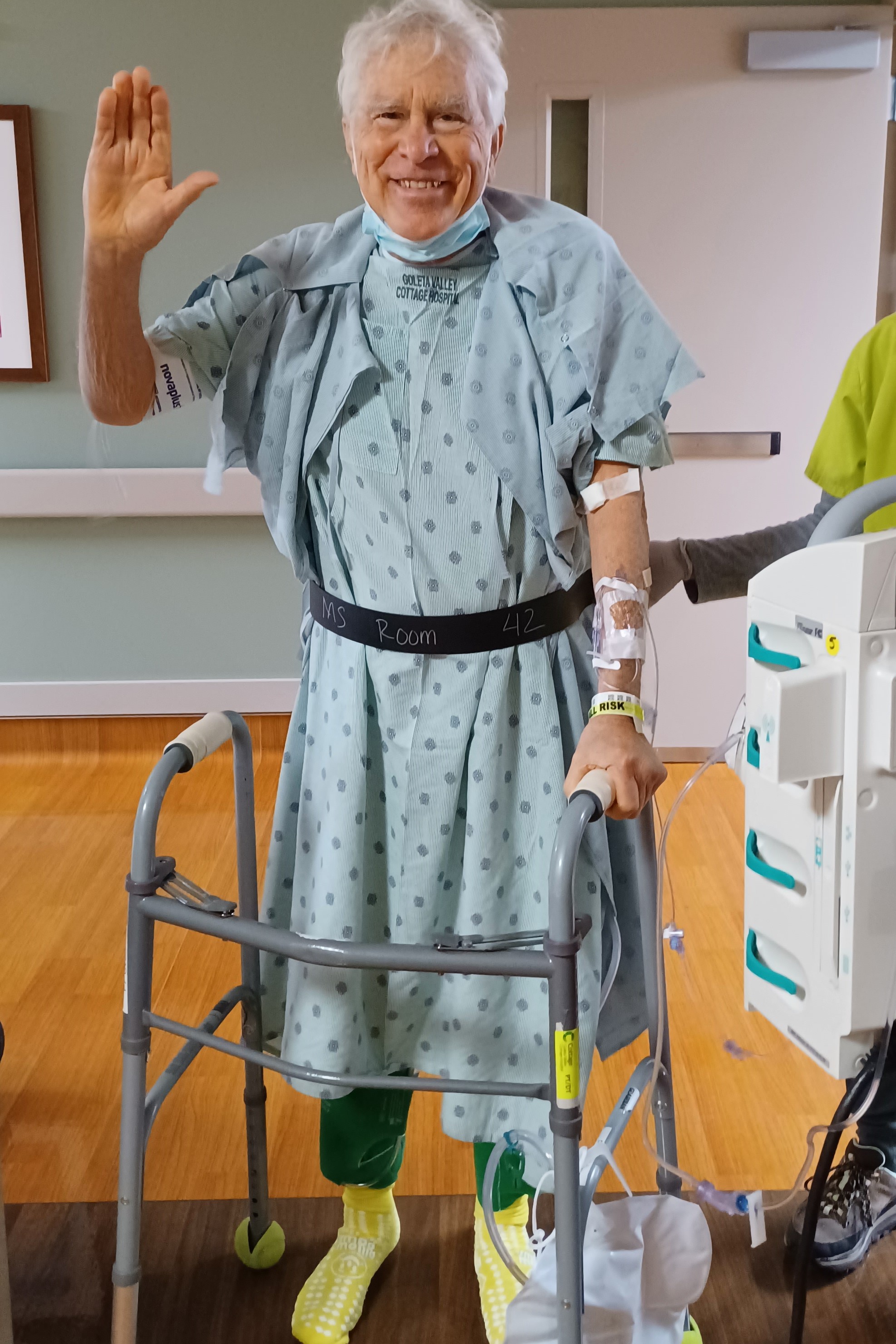
Within hours after the surgery the anesthesia had worn off and I was able to walk. In the days since then I continue to exercise my leg. There is little to no pain, and I walk better after the surgery than I did before,

When I talked with the health insurance representative before the surgery I thanked her profusely for denying my claim. She said she was used to getting angry calls from people rejecting their requests. Never, however, was she thanked for a denial.

But in my case, I told her, it saved my life. Well, at least it saved my knee.