
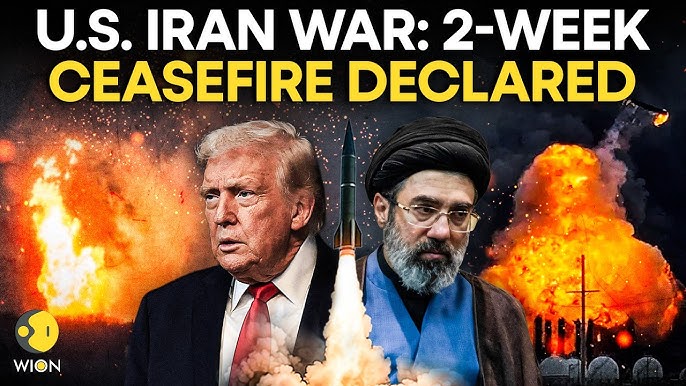
Now that a tentative cease fire has been announced bringing the US bombs into Iran to a halt, it is time to ask the logical question. Who won?
Certainly not the US. Trump basically capitulated to Iran in order to release its stranglehold over the Strait of Hormuz. It had effectively countered US bombs by choking off 20% of the world’s oil supply along with a third of the world’s nitrogen ingredients for fertilizer. Even Trump’s MAGA base was up in arms over the high cost of gasoline and fertilizer. So Trump was willing to essentially surrender.
The sheer cost of the 100-day military fiasco was staggering. The Pentagon admits exhausting almost 30 billion dollars in the war effort, and leaving thousands dead, including 13 US service men and women. The wider economic impact of the war has been estimated at almost a trillion dollars.
What did the US achieve with that? Go through the list of objectives that Trump had enunciated at one time or another in his shifting attempt to justify the war: the elimination of Iran’s nuclear capability; control of Iran’s oil production; regime change to a Venezuela-like transfer of power; the creation of a more moderate leadership willing to work with the US; the stimulus for a popular uprising against the regime.
None of these have happened. The situation is now worse than before the US attack, with a hardened regime and Iran’s continued manipulation of control of the Strait of Hormuz. And it is much worse off than after the five-nation nuclear restriction that was negotiated during the Obama administration. That not only had a pledge from Iran never to develop or acquire nuclear weapons, but also included an extensive monitoring system to make sure that the agreement was fulfilled. As you may recall, Trump tore that up during his first administration.
If Iran forced Trump to capitulate, then it won, right? Well no, since it is now far worse off than before the war. Not only has much of its nuclear and military infrastructure been devastated, its leadership cadre has been decimated. The new leaders lack experience and tend to be more ideologically driven than their predecessors. The Iranian people bear the brunt of these disasters, suffering from a collapsed economy and violently controlled by paranoid leaders.
Well then, Israel should be happy, since it was Prime Minister Benjamin Netanyahu who urged Trump to attack Iran in the first place. For a while, the Israeli public was wildly happy, thinking that their long enemy, Iran, and its ally, Hizbollah in Lebanon, would be vanquished. That didn’t happen, and when Trump wanted to capitulate, the mood in Israel soured against both Trump and Netanyahu. The telephone conversation between the two on the day that the deal with Iran was announced—on Trump’s birthday—was described as “difficult.” So Israel didn’t win either.
Neither did all of those ex-patriate Iranians who hoped that finally the evil regime was finished. It now is worse. Their hopes have been crushed.
Other Arab countries in the area have also been wounded from the Iranian shelling from missiles and drones. Moreover, their faith in the US as a reliable partner to maintain stability in the region has been shattered. US-Middle East relations may take some time, if ever, to restore to its previous cozy state.
Even Russia, the one country that has profited most from the war since it elevated the prices of its own oil in sales to China, India, and elsewhere, has not won from the fighting’s end. Even partial opening of the Strait of Hormuz means a lowering of the global price of oil, greatly affecting Russia’s income.
So after the Iran war it seems no one really won. Then who lost? It is like the old Agatha Christie mystery about who committed the murder on the Orient Express: everyone.